PeriodIndex
Imperial Roman

Sculpture from the Imperial Roman period.
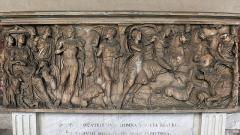
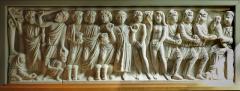
Sarcophagi - Camposanto Pisa
These 2nd and 3rd century Roman sarcophagi in the Camposanto, Pisa, were the inspiration for the beginning of the Italian Renaissance sculpture of the 13th century. In particular the Phaedra Sarcophagus, pictured above, was the model for Nicola Pisano's Madonna, and animal scenes on the pulpit in the cathedral.
Roman C4 Sarcophagi - Barcelona
Located in the Museu Frederic Marès this 4th century Roman Sarcophagus features Christian themes.
Anglo Saxon Sculpture
Ango Saxon sculpture is divided into two main periods, that before the 9th century Danish invasion and that after King Alfred (871-899). The period covers a period from the earliest Christian crosses, and includes stone decorative elements in churches depicting grotesque animals and fiugures intertwined with vine tendrils.
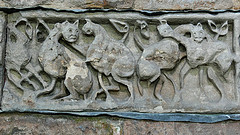
Anglo-Saxon Friezes from Breedon-on-the-Hill
Examples of the friezes and fragments of stone carvings from the 8th century Anglo Saxon monastery at Breedon-on-the-Hill.
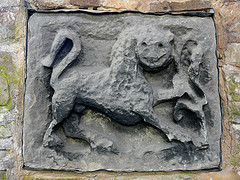
The Anglian Beast and Animal Friezes from Breedon-on-the-Hill
Striking animal reliefs, carved around 800 CE, are among the finest surviving examples of Anglo-Saxon sculpture from the Mercian kingdom. They were originally part of the 9th-century monastery at Breedon-on-the-Hill and are now set into the walls of the later Augustinian priory church of St Mary and St Hardulph.
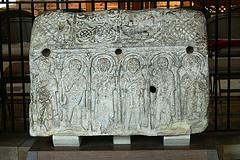
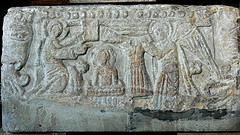
Two Prophets with Leaf-Topped Rods
This relief belongs to the important group of Anglo-Saxon sculptures from Breedon-on-the-Hill, dating from the late eighth or early ninth century. Carved in local sandstone and set within a rectangular frame, it depicts two standing male figures rendered in high relief beneath an architectural arch. Both figures are shown in long, pleated garments and hold leaf-topped rods in their right hands, a detail that identifies them not as craftsmen or labourers, but as prophets or inspired teachers.
William I Duke of Normandy - Rouen Cathedral.
This tomb of William I Duke of Normandy (d942) in Rouen Cathedral dates from the 14th century. The earlier burial had been in the ancient sanctuary near the end of what is now the nave.
Romanesque sculpture
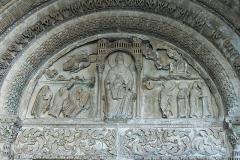
Romanesque is a term given to architecture and art from 1000 AD until about 1150 AD when it was succeeded by the Gothic. The term Romanesque was first used by the French antiquarian Charles-Alexis-Adrien de Gerville in a letter to Auguste Le Prévost (1818).
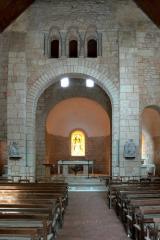
Meusnes - St. Pierre
The church of Saint-Pierre at Meusnes dates from the mid 11th century,1 and is in the typical style of the Roman basilica, shaped as a cross with three apses.
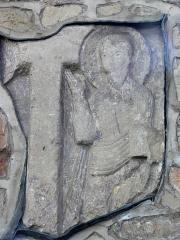
Norman sculpture of Saint - Breedon-on-the-Hill, Leicestershire
Fragment of saint giving a blessing.
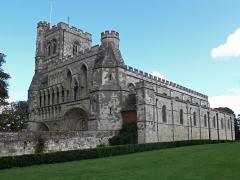
Dunstable Priory
Dunstable Priory, formally the Priory Church of St Peter, was founded c. 1131–1132 by Henry I as a house of Augustinian Canons. Strategically sited at the intersection of two major ancient routes—Watling Street and the Icknield Way—the priory occupied a key position within England’s medieval road network, a factor that profoundly shaped both its prosperity and the development of the surrounding town.
Robert Curthose, Duke of Normandy - Gloucester Cathedral
Robert Curthose (d1134) effigy, of painted Irish bog oak, was made about 100 years after his death.
Gothic Sculpture
The Gothic period is characterized by the early simplicity of naturalistic figures to the late excessively enriched elegance and elaborate clothing of the figures in the later period, the subject matter of Gothic sculpture featured the mysticism of the mid to late medieval age with an emphasis on suffering and emotion.